Module 6 - Let's abstract
What is abstract art?
The Tate defines it thus:
"Abstract art is art that does not attempt to represent an accurate depiction of a visual reality but instead use shapes, colours, forms and gestural marks to achieve its effect"
Quite simple then!
We will all have quite different images in our heads when someone mentions abstract art, probably several. A purist might say that there's no such thing as an abstract still life because if you can see what it is then it's not abstract; but you could equally say that if a painting doesn't look exactly like what it is representing then it's an abstraction, it's certainly a stylisation or an interpretation.
Start to think about what painting abstractly means for your work and how you think of it as a process and stay open-minded. As you will see from the video this module starts with, there are degrees of abstraction. As artists, we do already abstract without necessarily even thinking about it. If you ever leave something out or simplify or extrapolate from something, you're abstracting. So how far might you go? I hope the exercises in this module will help to clarify what this means for you right now and help you to venture into new work that is probably a lot more exciting that what I can show you in short videos. You are you, do you.
Think about how you're grouping objects, the space in between, opacity and transparency, the angles, repetition and difference, your viewpoint and how that changes the shapes of what is in front of you. If you want to alter what you see, how you will do that? Why do you want to do that?
Maybe you love to stylise objects and enjoy using lettering and pattern in your work and abstraction is just a minimal part of what it could be like. Or perhaps you relish the idea of getting so loose that the set-up in front of you, once painted, will not be easily read but will be fascinating to look at for anyone who loves layered colour and texture. Or you may want the rigour of distilling shapes to their essence in a more precise geometric way.
In the following introduction, I say that you could approach the abstraction of still life from your imagination. For some of you, this will be really challenging, for others coming to this course from an abstract angle in the first place that may be second nature.
Artist Chris Liberti says
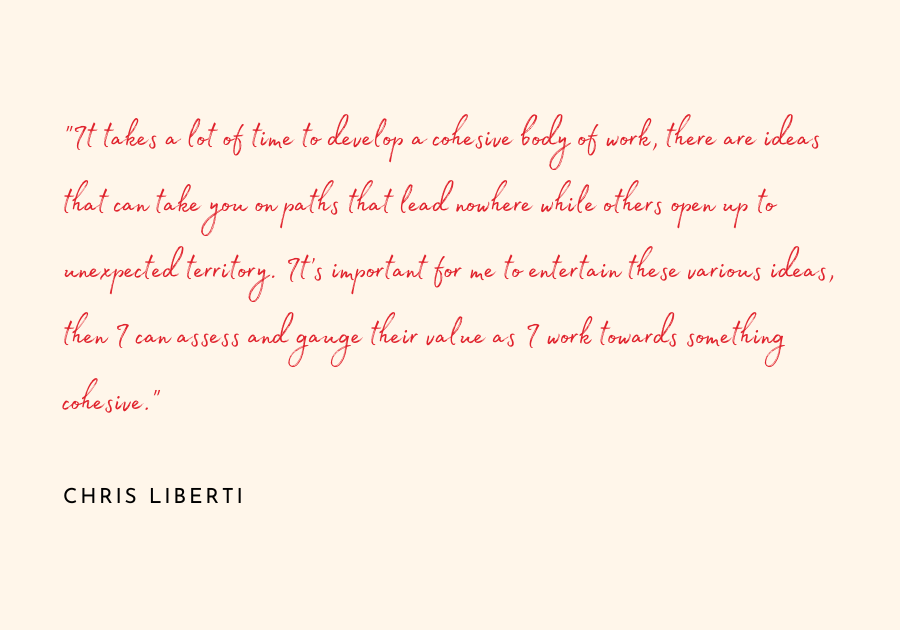
I think that this approach is the premise of this entire course.